Pages

Monday, February 17, 2014

On Presidents Day, Here's to a Founding Father Who Never Became President

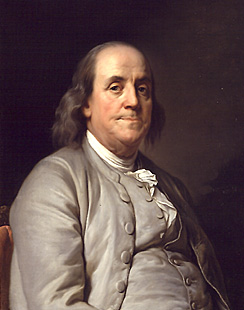
Benjamin Franklin
Portrait of Benjamin Franklin, circa 1785, by
Joseph-Siffrein Duplessis, courtesy of
the National Portrait Gallery, Washinton
Deemed "The First American" by H.W. Brands in a biography, Benjamin Franklin is one of the most pivotal figures in early American history; although he never became president, he nonetheless deserves mention with those who did.

Franklin was born January 17, 1706 to Josiah Franklin and his second wife Abiah Folger, Puritans living in Boston, Massachusetts.  Franklin ran away to Philadelphia, PA at the ripe young age of 17, working in various printing shops.  By 1727 at the age of 21, Franklin had formed the Junto as a place to discuss morals, policics, and natural philosophy.  In 1736, he created the Union Fire Company as Philadelphia's first volunteer firefighting company.

Fast forwarding many years and many accomplishments (The Pennsylvania Gazette, Library Company of Philadelphia, American Philosophical Society, Justice of the Peace for Philadelphia, etc.), Ben Franklin found himself in London in 1765 arguing on behalf of the Colonies against the Stamp Act.  His testimony eventually led to the repeal of the Act, and resulted in Franklin becoming a leading spokesman for the Colonies.

On May 5, 1775, Franklin returned after his second mission to England, with the fighting between the Colonies and the British already begun (the Battles of Lexington and Concord began on April 19, 1775).  The Pennsylvania Assembly unanimously nominated Franklin to the Second Continental Congress, and in June 1776 he was appointed to the Committee of Five to draft the Declaration of Independence.

Franklin served as the first United States Postmaster General, was ambassador to France from 1776-1785, served as the sixth president of the Supreme Executive Council of Philadelphia (fancy speak for governor), and late in life was a leading figure for the abolition of slavery in America.

Benjamin Franklin died at his home on April 17, 1790, age 84, after leading an eventful and important life for early America.  Today, he is still remembered on the $100 bill, as the name of numerous warships, and towns throughout America.  Another interesting fact was that he bequeathed 1,000 pounds ($4,400, or approximately $112,000 in 2011) to the cities of Boston and Philadelphia to appreciate for 200 years before being spent.  Through that miracle called compounding interest, more than $2,000,000 had accumulated in the Philadelphia Trust and $5,000,000 in the Boston Trust by 1990.  Philadelphia ultimately spent its money on scholarships for local high school students, and Boston used it to establish the Benjamin Franklin Institute of Technology.

Benjamin Franklin and Mead
For those readers left wondering why on a blog dedicated to mead and its production I would devote this time to Benjamin Franklin (other than the semi-obvious, it's Presidents Day and we need make mention), here is some more wonderful trivia for you.  On 19 December, 1789, Benjamin Franklin wrote:
Dear Friend: -- I have received your kind Letter on the 5th Inst., together with your present of Metheglin, of which I have already drank almost a Bottle.  I find it excellent; please to accept my thankful Acknowledgements.
'Tis a shame little is known of who this letter was addressed to, or the underlying recipe in reference.  But here's to an influential man in early America, a Founding Father, and for those in the know, a lover of mead!

Monday, February 10, 2014

Want to make mead? Check out these great resources.

So, you are interested in mead.  But not just in mead, but in making mead.  And somehow you got here.  Really, I don't know how... I don't advertise, I don't post to twitter or facebook.  Maybe I'm just lucky.  Or you are just my friends!  Anyway, I'm happy to have you, and hope you come back.

But back on topic, where is the best place to learn about mead?  Although mead has been around for many millenia, it doesn't have the same background of knowledge available to it that beer and wine do.  Having gone out of favor sometime between the Middle Ages and end of the Renaissance, mead hasn't seen the same interest throughout the 19th, 20th, and 21st centuries as other fermented and distilled beverages.  In this post, I will highlight some good to great resources for the beginner, and hopefully steer you in the right direction.

Gotmead.com
Considered by many to be the premier resource for beginning meadmakers, this website has most everything you need answered either in their NewBee Guide or buried in their forum.  I can't stress enough that if you are interested in making mead, the patron membership is well worth the $25 expense.  The members are friendly, and possess vast amounts of knowledge that hasn't made it to the written press.  Even in just the last 10 years, mead has seen many changes in its production processes, and this location is your best bet to uncover the latest methods.  They even have a thread going on how to create drinkable mead in a month.  Now that's impressive!  (See Bray's One Month Mead, or BOMM).

The Compleat Meadmaker, by Ken Shramm
The Compeat Meadmaker is far and away the best published resource for meadmaking.  Targeted to the beginning homebrewer, this book explains many of meadmaking concepts and takes you through your first mead batch (if you don't follow the JAO path outlined through Gotmead and many other homebrew sites).  It includes chapters on yeast and fermentation, honey varietals, and the various ingredients available to the meadmaker.  The book also provides a good beginning resource for mead recipes to try.

BJCP Mead Study Guide
I recently stumbled upon this, and was amazed at the amount of information contained within, all for free.  The Beer Judge Certification Program has added a mead judge certification to their offerings, and contained within the study guide are copious amounts of information honey varietals, mead types, and the various flavors associated with these.  Much of the guide references the certification program itself, so if you aren't into that, feel free to ignore those parts.  The rest has very valuable information to those looking to better understand the comments on a judge's scoring card, or the terms used in the wine-tasting world.

Scott Laboratories 2013 Fermentation Handbook
Focused on the yeast and fermentation offerings from Scott Labs, this Handbook nonetheless provides valuable information to both the home meadmaker and professional alike.  Topics include the different yeast strains available through Scott Labs, the best nutrient combinations for these, additional flavor components (specifically tannins), and a host of other fermentation topics.  Those only interested in making something family and friends can drink without getting into the nitty gritty details can likely avoid this reference, but valuable information awaits those wanting to step up their game.

The American Mead Makers Association (AMMA)
Started in 2011, the AMMA has four overarching objectives: to improve regulation that promotes the mead industry, to educate consumers about mead, to conduct research to improve the craft, and to promote mead in general.  Now that may seem overly focused on the professional aspects of meadmaking, and admittedly it is, but the AMMA also provides information of interest in their quarterly newsletter.  And if you want to see more mead on the shelves at your local liquor store, maybe consider becoming a member.

So, that's five great places to start learning about mead.  More and more are popping up, with rumors of new meadmaking books in the works.  The UC Davis Mead Short Course will also have a recording of its first ever mead class from this past weekend available soon.  And I'll continue to post here with cool things going on with Terrapin Bluffs, and the industry in general.

Got any references you hold dear?  Post them in the comments section for all of us to learn too!

Monday, February 3, 2014

So, What is Mead?

Looking back over the last year, I never properly explained what mead is (aside from a poor description in The Beginning).  From a very simple perspective, mead is the result of honey, water, and yeast left to ferment until alcohol has been created.  On a more technical note, I like to think mead is any alcohol beverage where more than 50% of the fermented sugars originate from the honey.  Beer, likewise would be a beverage fermented from greater than 50% cereal grains (typically malted barley or wheat), wine is from greater than 50% grape juice, and cider is from greater than 50% apple juice.  Well what happens if we decide to mix them up, and we want to make a mead + beer combination, or a mead + cider combination.

In the mead world this is simple.  Many variants of mead exist, just as many beer types exist.  Here is a short example of that list.  Note, for the purposes of my definition, at least half of the fermented sugar for all of these types should come from honey.

Meads are generally categorized as having three different alcohol strengths as follows.  Note, these distinctions can be combined with all of the later definitions, e.g. cyser of hydromel strength, or metheglin of standard strength.

  • Hydromel (or session): This is a low alcohol mead, often served carbonated similar to beer.  It will have a final alcohol by volume (ABV) level of 3.5 - 7.5%.  
  • Standard Mead: This is a mead of table wine strength, that is, 7.5 - 14% ABV.
  • Sack Mead: This is a mead of high alcohol content, greater than 14% ABV.


There are two categories of mead where honey is the only fermentable.

  • Traditional Mead: These are meads fermented with honey, water, yeast, and yeast nutrients.
  • Show Mead: This category defines those meads fermented only from honey, water, and yeast.  These meads do NOT have additional nutrients added to the must to improve fermentation.  They often will take a long time to completely ferment as nothing is there to help the yeast, and may take even longer aging to smooth out the flavors produced during a relatively stressful ferment.


The following are the types of fruit meads available.  A general mead from fruit and honey is classified as a melomel, but specific names have been given to many of these combinations.

  • Melomel: This is a mead fermented with fruit.
  • Pyment: This mead is fermented from honey and grape juice.
  • Cyser: Pronounced sizer, this is produced from honey and apple juice.
  • Morat: Mead from honey and mulberries.
  • Capsicumel: Mead fermented from honey and chili peppers.


Then there are the metheglins, grouped as such for convenience, even though some are stretching it.

  • Metheglin: Mead made from honey and a combination of spices, added either during or post fermentation.
  • Rhodomel: Mead fermented from honey and rose petals.
  • Braggot, bracket, or brackett: Originally, this was a mead fermented from honey with hops added, but this category has evolved to include meads fermented with malted grains in addition to the honey.

The following two meads really do not seem to fit any of the above categories as I have outlined them, but are worth mentioning as mead types.
  • Bochet: This is a mead fermented from caramelized honey.  
  • Acerglyn: This mead is from a combination of honey and maple syrup.

I also want to mention three traditional Polish meads you may find perusing the shelves of a liquor store.  Poland is one of the few remaining locations where mead has maintained its popularity since the Middle Ages, and three distinct polish styles are provided here. 
  • Dwojniak: A Polish mead made using equal parts honey and water.  This will typically result in a high ABV, sweet mead.
  • Poltorak: A Polish mead made with two parts water to one part honey.
  • Czworniak: A Polish mead made with three parts water and one part honey.

Lastly, I don't want to leave off Tej, an Ethiopian variety of mead fermented with honey and gesho.

If I left off any meads, and I most certainly have, let me know in the comments section.  Considering the number of fruits and spices available, the mead combinations are truly endless.  

Monday, January 27, 2014

Meadery Expansion!

The last few weeks I have been working on upgrading my "Meadery," that is, the closet where I ferment and age all of my meads.  After buying our house, I quickly claimed a closet in an extra bedroom for fermenting before we ever moved anything in.  This small, 36"x31" space is where all of my equipment should reside, but just having the floor and single top shelf was proving to be a problem.  I don't trust the top shelf to hold any weight, and my carboys, buckets and bottles were overflowing into all rooms of the house.  Add in the additional brewing equipment I received for the Holidays, and an upgrade was in order.


A full brewing closet, with carboys, bottles, and odds and ends all over the place.

Design

Given the constraints on space, I wanted to add a single mid-level shelf that could support the weight of six 5-gallon carboys.  The shelf also needed enough space both above and below such that you could fit a carboy with an S-type airlock attached, and still have a few inches to add water to the airlock as necessary. I wanted the shelf to span the full 31" width of the closet.  This meant it had to be built into the closet, as the doorway was only 23" wide.

Taking the inspiration from Ted's Fishroom, I decided to use a modified dado joint to create the shelf.  (Note: I also have a freshwater fish tank, that before I started brewing was fully stocked with white cloud mountain minnows and cherry shrimp, and aquascaped with assorted crypts, anubias, rotala and java fern.)  I added two interior 2"x4" spacers so that my plywood shelf would not bow under the additional weight.  While fish tanks can be fully supported on their two long sides, my carboys carry the same weights, but the round bottom needs to be supported on all sides.  I also drilled two outside spacers into the studs as additional support.  This mitigates any issues from knocking the legs on accident and causing the shelf to topple.  

A 5-gallon Better Bottle plastic carboy is roughly 26" in height when the airlock is attached, so I planned for a minimum of 30" space on the middle and bottom shelves.  Measuring floor to the bottom of the hanger bar already installed in the closet, I had 68" of space.  This was just enough to fit in my design as I needed to take into account the additional height of the 2"x4" cross members with the 3/4" plywood shelf.

Left: The empty closet. Center: The initial frame with the back legs and two interior spacers drilled to the back cross member.
Right: The finished shelf. 

Over the course of 3 days, and what felt like way too long considering the simplicity of the design (but at least it is level!), I finally put the last screw into the shelf.  Of course, after building it, I still have leftover equipment in the house.  But a haphazard carboy or two is far better than where I began!

The completed closet, missing two 5-gallon carboys, a 1 gallon carboy, and a 1/2 gallon carboy, all currently in the center of our living room floor under MEA-watch.  Looking closely, you can see the blackberry stain created by the first mead made on the new shelf.

Tuesday, January 21, 2014

Do MEAs a Mazer Make?

It took me four and a half years, but I have officially created my first mead eruption accident (MEA).  A MEA happens when a batch overflows from its carboy or fermenting vessel, often resulting in the unintentional remodeling of the kitchen, basement, or closet you conduct your fermenting in.  I missed the chance to take photos this morning as the accident was found minutes before leaving for work and resulted in a half hour delay of my arrival, but if the batch blows again I will be sure to update!  Luckily, this was on top of my newly constructed shelf (next blog post, hint hint), keeping the mess contained.  Only about a cup of mead was lost to the eruption, and it now sits bubbling along, ever threatening a repeat disaster.

So what happened?
Last night, I started a Blackberry Bliss batch, this time increasing the blackberry from 60 ounces to 84 ounces (seven large grocery store containers).  The batch also has a pint of blueberries, approximately 17 pounds of orange blossom honey, 5 "mushy" raspberries, with water to 5 gallons.  This was all mixed together in a 5 gallon carboy and Fleishman's Active Dry Yeast was added (admittedly, most of the honey is still not dissolved, but the yeast will eventually make its way through the sugars).  I thought I left enough headspace to avoid the dreaded MEA, but fate would have it other ways.

Can you avoid it?
MEAs are easily avoided if you have the right fermentation equipment.  Your best bet is to always ferment in buckets, leaving the carboys for aging.  Also, you should ferment in containers significantly larger than your must, think at least 1 gallon more space than you have in the batch.  Unfortunately, I do not have a 5 gallon brewing bucket or anything larger (yet! My honey pail will become one as soon as I have used the remaining gallon of honey in another batch).  During fermentation, be sure to stir the batch regularly early in fermentation to degas the mead (this releases the CO2 in solution so you don't have it release unbeknownst to you in your fermenting closet).  In heavy fruit batches, it is also a good idea to add anti-foam drops, but alas, I was unprepared.

If it does happen, you should split the batch into multiple fermenters.  This will allow you to increase the headspace per fermenter, making it less likely to erupt again.  Next, ensure to manage the cap (the layer of foam and must ingredients that forms at the top of the carboy/bucket during fermentation) by punching it down frequently into the must.  This requires stirring the mead such that the cap is completely submerged, and the bubbles are minimal on the surface.  This may be every hour, or just twice a day; it will depend on your individual ferment.  In this batch, if I leave it more than 15 minutes it is likely to erupt again, even after extracting 1/2 gallon from the carboy.

Do you have a MEA to confess to, or any additional ideas on how to manage it?  Let me know in the comments below.  The Mead Eruption Accident Decrement Society (M.E.A.D.S.) is excited to hear about your experiences!

Friday, January 17, 2014

Christmas Gifts


I'd like to take this opportunity to thank everyone who added to my mead supply collection!  This year, I received four new 1 gallon carboys (edit: and one bottle capper!) courtesy of my sister, brother-in-law, and nieces.  My parents got me new carboy bungs (stoppers) and airlocks, as I realized I did not have enough to brew with my complete collection of equipment.  I also received two fun books, Making Wild Wines and Meads and The Drunken Botanist from my mom.  Looking through the first, I have some fun ideas for the fruits we have growing in our backyard, especially the mulberry tree.  Hopefully the crows don't eat all the fruit this year!

I also purchased some chemistry equipment for myself to improve my yeast capture experiments. (I swear at some point I will post about the process and what results I am getting!) The cache includes test tubes for storing yeast, plastic pipettes to extract the yeast cakes from completed fermentations, 60x15mm petri dishes for isolating yeast, and the requisite agar-agar powder to use the dishes.  Lastly, I bought Wild Brews: Culture and Craftsmanship in the Belgian Tradition to learn about the procedures the professionals use for yeast capture.  I haven't made it through the book yet, but at first glance it is a good reference for my experiments. 

Again, thank you everyone for the new equipment!  It will come in great use for making this next year's batches.

Thursday, January 9, 2014

Holiday Special, Part II

When I wrote the Part I of the Holiday Special series, I fully expected I would have good news to report for part two.  I had made a 2 gallon batch of Spiced Cherry Cyser 2 years ago, and remembered it being rather tasty the last time I tried it (over a year ago now).  It was left aging in a 1 gallon and a 1/2 gallon carboy.  Unfortunately, only a single bottle was opened for our Winter Solstice gathering, despite having 16 available.  Nevertheless, I provide this to you as background so that you can avoid the same mistake.

The recipe was as follows:
2 gallon batch

  • 1 gallon Trader Joe's Spiced Apple Cider
  • 1/2 gallon Trader Joe's Cherry Cider
  • 3 lbs Mesquite Honey (also Trader Joe's... anyone sensing a pattern here?)
  • Water to 1.092 SG (12% potential ABV)
  • 1 packet D47 yeast (would take the batch dry, which is likely the problem I encountered)


I followed a semi-staggered nutrient addition, adding half the nutrients at pitching and the other half 15 hours later.  I also aerated regularly during the first half of fermentation.  I left the mead on the yeast for a little sur lees aging, and after 5 months racked it from the bucket fermenter.  At the time, it had nice notes of spiced apple cider minimal cherry flavor.  There was no off flavoring from the yeast, just wasn't my favorite since the batch went dry.  I added a little bit of honey to a glass to test backsweetening, and my wife (who prefers sweeter drinks) absolutely loved it.  With that said, I hoped this would be a great option to serve for our Winter Solstice Gathering

This batch was finally bottled 5 days before they gathering, and that was when I noticed something tasted off.  I worry the main issue with the batch was that I let the airlocks dry out and oxidized the mead.  I do not have experience with oxidation, so I don't know what to taste for other than wet cardboard, and that isn't exactly the problem.  The mead tastes very tart from the cherries, with a kick of cinnamon, nutmeg and clove from the spices.  The apple is also present, although the tartness dominates.  The tartness and spices do not go well together, especially without any sweetness to balance it.

Determined to get tasting notes, I served small samples to a handful of guests to gauge their reactions.  Noting that many do not like mead as they've only ever tasted it sweet, I was wondering if someone who liked dry wines could comment and provide any additional feedback.  Alas, none of my family fits in that dry wine category, and only one guest had anything positive to say.  A few were nice enough to finish the bottle, although they grimaced through those last few sips.  For now, it is back to the drawing board with this batch.  I will likely age for another year and open at Christmas just to see the difference.  If the perceived sweetness comes back over time, it might just turn into something drinkable, if never special.

I still believe a cherry and apple combination should go well together (see Zombie Killer), it just can't finish dry or with spices.

Wednesday, December 18, 2013

2013 Holiday Special Part I

This holiday season, I have bottled two batches and labeled these as gifts for friends and family.  This is a discussion of the first, TBM's Merry Mead.  I'll cover the second as I finalize the label and bottle the batch.

Merry Mead

Merry mead was a recipe created from the dregs of one of our Wedding Meads.  During the bottling process for the Blackberry Bliss, I realized there was approximately one gallon left of blackberry and blueberry mush (the fruit had dropped out of suspension during the fermentation, and was not pressed to harvest the remaining liquid).  Seeing the opportunity, I quickly added 12 pounds of orange blossom honey, topped the carboy up to 5 gallons, pitched some more yeast, and let it ferment.  

The Merry Mead Label

I have never had any problems with bread yeasts creating off flavors during prolonged aging, so the five gallon carboy remained buried in a closet for months.  After nearly a year of primary fermentation (20 Nov 2012 to 18 Nov 2013) this mead was racked to a 3 gallon and a 1 gallon carboy.   The 3 gallon carboy came out perfectly clear, but the 1 gallon still has some remaining lees to settle.  Merry Mead is exclusively from the 3 gallon carboy, bottled on 16 Dec 2013.

I am very satisfied with the final product.  The berry flavor compared to Blackberry Bliss is barely perceptible, leaving the orange blossom honey and cinnamon as dominant flavors.  The cinnamon leaves a slight numbness to the tongue during tasting (similar to the effects of cloves, but I've double-checked the recipe and couldn't find any in my notes).  The mead finished very sweet, but not cloyingly.  There is enough residual acid and cinnamon to create a balanced mead, highly drinkable and great as an after dinner apertif.

Given the recipe process, I don't have an accurate measure of alcohol content for this batch, but have approximated it around 10%.  The previous Wedding Meads settled in right around 10%, and it is doubtful this batch made it much further.  After a single glass you could feel the punch.

For those family members and friends lucky enough to get a bottle this year, I'd love to hear your feedback.  Let me know what you think in the comments below!

Monday, December 9, 2013

Pumpkin Apple Bochet

Here is a little batch I put together last week, using some leftover ingredients frozen last year.  Let me know what you think!  No word yet on whether it'll be any good, but initial tastes give me hope it'll turn out alright.

Recipe:
1 frozen baking pumpkin (cubed last year while uncooked, frozen)
1 pint granny smith apples (frozen, cut into small slices)
6 lbs orange blossom honey
1 packet D47 yeast
Depending on flavor, may add pumpkin pie spice (cardamum, cinnamon, clove) after primary fermentation
2 tsp yeast nutrient (3/4 tsp at pitch, 3/4 at 24 hours, 1/2 tsp at 48 hours)
1 tsp yeast energizer (1/2 tsp at pitch, 1/4 at 24 hours, 1/4 tsp at 48 hours)
SG = 1.123 (15.88% potential ABV)


Process:
Bake frozen pumpkin at 400 deg F until roasted (15 to thaw, break up pieces into pan; 20 minutes, flip pumpkin pieces; cook additional 40 minutes, mush pumpkin in pan).  Remove pumpkin from heat.


 The pumpkin baking process. Top left, frozen pumpkin and apples. Top right, partially thawed. 
Bottom left, partially baked. Bottom right, baked and mushed together.

Boil honey and 2 cups water (used to dissolve honey remaining in container) until honey is dark golden with a good portion burnt (approximately 1 hour), stirring continuously.  Add one half gallon cold water at the end of the boil to cool the honey, and redesolve the now very thick, somewhat burnt honey.  Chill to 70 degrees.

Boiling the honey. Be careful, honey volume will increase greatly during boil.  I used a 5 gallon brewpot to boil 1/2 gallon of honey, and nearly had the honey boiling over.

While must is cooling, rehydrate D47 per packet instructions.  Add pumpkin and frozen apple pieces to cheesecloth bag over brewing bucket. Tie cheesecloth bag.  Add rehydrated D47 to bucket, and let sit while bochet must cools.

 Adding pumpkin and apple pieces to the cheesecloth. Tie the cheesecloth bag well. This will ensure a minimal amount of pumpkin and apple pieces drop into the fermenting bucket, to minimize racking losses.

Pour boiled honey into fermenting bucket with apple and pumpkin cheesecloth bag.  Add water to 2 gallons.  My original SG was measured as 1.114 (14.84 % potential).  Add 3/4 tsp yeast nutrient and 1/2 tsp yeast energizer.

Ready to ferment. Bubbles on the top are undissolved pieces of burnt honey.

Follow yeast nutrient additions as outlined above.  Aerate twice daily during initial fermentation, and punch down cheesecloth to discourage spoiling organisms from growing.

Since this is D47, make sure to ferment under 70 degrees.  We keep our house at 67 during winter, so hopefully I'll be okay on the temperature requirements.


Notes from the batch so far:

  • Mead is very slow to start.  Evidence of krausen formation from must on the bottom of the bucket lid, but no foam was noticeable on the surface after 24 hours.  During stirring, a good 1/2 layer of foam formed, but dissipated rapidly, leaving me to believe this recipe will not foam much.  
  • Original SG was 1.114, but after 24 hours had jumped up to 1.123 as stated in the recipe above.  I believe this is caused by the burnt sugars dissolving after pitch and additional sugars from the pumpkin and apples leeching into the must.
  • Tastes very much of toffee, no noticeable pumpkin flavor, and hints of apples.  Am intrigued to find out where this goes.  Tastes good now, but bochets may turn out to be too 'dark' for my tastes (I'm thinking stouts/porters, but without the body).

Friday, November 8, 2013

Let's Make a Stirplate

The last two weeks, I have been working on completing a home-built stirplate.  A stirplate allows a meadmaker (or homebrewer) to culture a larger yeast colony than what comes in the yeast packets or vials prior to pitching.  A yeast starter better acclimates the yeast to the must, and improves fermentation rates due to the healthier yeast and larger starting colony size.

My design for the stirplate is based on the one available at stirstarters.com, with a minor modification to the resistor and potentiometer.  The smallest potentiometer available at Radio Shack was 5k-Ohm, so I was forced to increase the resistor size accordingly to ensure a proper voltage drop across the fan.

The supplies (all prices at Radio Shack unless otherwise listed):
  • 1 SPST Sub-Mini Switch ($3.49)
  • 1 micro-F Capacitor, 2 pack ($1.99, $1 each)
  • 5 k-Ohm Linear Potentiometer ($3.49)
  • 680 Ohm Resistor, 5 pack ($1.49, $0.30 each)
  • LM317T Voltage Regulator ($3.49)
  • Breadboard ($3.49)
  • 8"x6"x3" Project Box ($8.99)
  • Four 3" machine screws ($1.26 x2, extra needed for additional nuts to mount fan)
  • 12 V computer fan (free, salvaged from an old computer build)
  • 4 D83 Neodymium Magnets (free, leftover from another project, usually $1.33 each)
  • 12 V 1 Amp power adapter (free, harvested from old Verizon router)
  • 22 AWG wire, soldering iron, lead free solder, electrical tape, hot glue gun (price not included)
Total price, tax included: $28.38 ($34.02 with magnets included, fan likely less than $10 additional)


Following the schematic from stirstarters, I laid out all the components and got to work building.  I highly suggest that anyone working with electronics have the appropriate multimeter, and measure the system components before soldering into place.  I should also warn you that the potentiometer will catch on fire, I repeat, it WILL catch on FIRE, if you short the voltage regulator.  Just be careful; I will not be held responsible for any accidents that occur.

Not knowing the pin layout for the LM317T and the potentiometer, I sought some help from a friend working on the same build.  You can find information on the pin layout for the LM317T here.  The potentiometer layout can be found here.  Note that you can reverse terminals on the potentiometer to control the clockwise/counterclockwise rotation of the potentiometer corresponding with an increase in power to the stirplate.  My design used the middle terminal for input, and the ground terminal as the output.  I only wired to two of the pins.  Test it out with a multimeter, and see what you prefer.

It had been years since the last time I put together an electronics project, but the build was easy enough.  First-timers shouldn't have any problem securing all the wires together.  And if soldering doesn't appeal to you, you can add some connectors to the supply list to complete the build.

           The Work Area                        Finalized wiring, Fan removed

All Screwed Together

Once finished, I put it through a test using a 1 gallon carboy filled 3/4 to the top.  Sure enough it created a steady vortex, more than enough for building a good yeast starter.  I still need to trim the potentiometer and add a knob, but looks weren't what I was going for.  It is functional, and more than capable for my needs.  Success!

Completed Project with Steady Vortex

Thursday, October 17, 2013

Brewing Season is Upon Us

Now that the Maryland weather is cooling down, I can return my focus back to making meads again.  During much of the summer, the 84 degree temperature inside doesn't bode well for fermentation.  Most yeasts prefer temperatures between 65 and 75 degrees.  Lacking a way to control this, I tend to shelve the idea of making meads (unless they prefer high temperatures) and wait for the fall.

With the changing leaves, I have plans to start experimenting with local yeast capture.  We have a few eastern red cedars on our property with mature berries covered in yeast blooms.  I'm currently working to build a stir plate (plans at http://www.stirstarters.com/), with the intention to focus all winter on meadmaking with a local yeast.  At the same time, inspired by places like Blue Dog Mead and Leaky Roof Meadery, I will focus on low alcohol by volume meads, ideally in the 5-8% abv range.  I also want to try my hand at bochets, or caramelized honey meads.

I will spend part of the time updating you on my plans to turn my backyard into a local fruit paradise.  Right now, we have blueberry, blackberry, chokeberry and huckleberry bushes, with two very young persimmon trees.  Unfortunately none of these are old enough for any serious production.  Combined with the wild raspberries growing in our creek, over time I hope to make meads from these fruits.  I'll have to fight my wife for who gets to use the fruit (she does love to bake), but hopefully in time I'll have enough for us both to share.

I leave you with this recent article on the mead industry.  If mead is a canvas, what would you like to paint with?

Wednesday, September 25, 2013

New AMMA Publication

Thought I'd take this time to reference to the latest American Mead Maker's Association's (AMMA) newsletter.  Has some interesting articles on mead-food pairings, mead recipe design, an historical reference to mead (Pliny the Elder), and a recap of the 2013 Mazer Cup: AMMA Summer 2013.  If you missed the first two newsletters, they are worth a read as well.

For those who don't know, the AMMA is a relatively newly formed body with the following long-term goals:
  • Establish relationship with government officials
  • Member discounts at participating wineries
  • Reduced entry fees at mead events
  • Establish Mead Style Guidelines for legislation and competitions
  • Create Mead Judge Certification program
  • Clinics taught by industry leaders and subject matter experts
  • Mead science research
The organization is extremely young, only founded in May 2012.  I encourage all to support their local meadery, and in turn support the AMMA.  They may not seem like much yet, but show promise in promoting mead related causes in the coming years.  

And while you're at it, you should help promote fair regulations for the mead industry, brought to you by the one and only Ken Schramm, author of The Compleat Meadmaker: http://petitions.moveon.org/sign/revise-ttb-regulations.fb31?source=s.icn.fb&r_by=2503511

Tuesday, August 13, 2013

Beer and Liquor? Where's the Wine and Mead?

Found an interesting article on artisanal alcohol and boutique beer as great industries to start companies in 2013 (inc.com, beer liquor best industry 2013).  As a home meadmaker, it makes me wonder what leaves mead or wine off the list?  Numerous mead companies are sprouting up across the nation, and it is increasingly being carried in local liquor stores, as well as some larger chains.  Wine might be a saturated market, but the local economy still stands.  Having lived in both Virginia and Maryland, these states are actively pushing the growth of wine within their borders.  Is the barrier to entry any different?  Or have wines already become saturated, and is mead still its own cottage industry (despite a recent article in Popular Mechanics and being named to the Forbes 2011 food trends)?

One day I'd love to start my own meadery, and articles on craft brewing and the increase in the market is inspiring.  Following startups and new meaderies on kickstarter gives me hope that the business idea could work (meaderies on kickstarter), although my plans are far more ambitious.  At some point it will have to reach the popularity of craft brewing to ever take off.  So that's what gets me writing here.  Go out and support your local meadery, and if you can't find one, for the time being a local brewery, winery, or distillery will have to do.

Sunday, July 21, 2013

Wedding Mead


It was a beautiful day in April, as the love of my life prepped to walk down the isle.  My niece and first cousin once removed (what an annoying way to refer to a cousin's child) were clogging up the aisle.  Just moments before they were so happy to play with the rose petals, and now that they had to actually do it, they froze and threw off the timing.  But you aren't here to read about my wedding and romance, this is about mead!


Terrapin Bluffs Mead made its first public appearance at my wedding (well, larger than serving to only a few people at a time).  I served the basic JAO recipe and a modified JAO made with blackberries and blueberries, each scaled to 5 gallons so there was enough to go around.  We served both as parts of the toast, to rave reviews from all of our guests.  


As part of the process, I developed a special mead label to signify the occasion.  We used a sunset paper cutout as the central design element for the wedding, so I thought it fitting to place it smack dab in the middle of the logo.  I still kept the TBM logo around, but rotated it and shrunk it to take second place behind the importance of the day.  We used appropriately colored ribbons to glue the logo to the bottles, giving it the final professional appearance.  


From the tasting notes, most of the wine-drinkers preferred the blackberry variety, although as a general rule the majority of the wedding preferred the traditional, unmodified JAO.  We were just happy to serve the mead, and have everyone with us for our wonderful wedding.  It was so great having all of you involved, and hopefully there will be more mead for all the guests come Christmas!

Wednesday, July 17, 2013

Time Flies...

Already two months since my last post, and I've barely said anything about mead.  Summer's are busy, but they shouldn't be so much that I can't write about something I care for.  I've got many ideas for new posts, and am dwindling in motivation to put pen to paper (fingers to keys may be more appropriate).  So, I'm going to post a public to-do list, and hope maybe in the coming weeks I'll get around to actually posting about everything.  I'll even update with links as they are completed.  I do this as my wife stares at me with those wonderful eyes, full well knowing she's thinking "Yeah, right..."  So here goes, the list of topics:

1. Our wedding and the meads I served (link),
2. The Mazer Cup, and the scores of the meads from the wedding,
3. The American MeadMakers Association (AMMA),
4. The dwojniak in primary, the only mead I've made in the last few months,
5. A note on buying kegs when you know nothing about the topic.  Shame on Midwest Supplies for offering 'as-is' kegs for cheap.
6. And finally a post on that most sacred of ingredients, the honey itself.

That seems like a good start.  With any luck, I'll be finished by next year...

Saturday, May 18, 2013

Designing a label

With Terrapin Bluffs as the name, I set out designing a logo.  I had defined a few requirements...  I wanted 7 scutes (the plates on a turtles shell) to coincide with the number of diamondback terrapin subspecies.  I needed a reference to bees, since everything I make includes honey.  And that was it.  A pretty large box to work in.

At one point, I even envisioned a turtle whose shell was built of honeycomb, and whose body was dripping with honey as it stepped from location to location, leaving little drops everywhere along the way.  It's eyes, nose and mouth were the opening to this moving hive.  This fully ambulatory honey hive was pretty cool in my head.  However, my art skills aren't that great, and I wanted something simpler anyway.  The honey turtle may still be a mascot one day, but it wasn't good for the label.

I eventually decided on a turtle shell with a hexagon border (honeycomb), with the Terrapin Bluffs name wrapping around the shell.

Here are a few of the early label designs, with 7 scutes in entirety.

The first design iterations, from winter 2012.


Early drawings of the turtle shell for the logo (summer 2012)

Now we're getting closer.  My carved pumpkin for last Halloween (Oct 2012).

Finally I realized I should include the namesake for the brand in the design, and decided to outline the shell in the image based on the shell on a real turtle.  I took the 7 scute idea from the pumpkin carving (1 large central scute outlining the typical 5 scutes down the middle, with 3 scutes on each side depicting where the 4 would normally be).  I started with a photo, and outlined the shell portions I wanted.
Last, it was just adding a layered hexagon, changing some colors, and there you have it, the TBM logo.  Thanks for reading!


Thursday, April 4, 2013

Why Terrapin Bluffs Meadery?

I contemplated long and hard what kind of name I would want for a meadery.  Did I want to evoke an image of something, choose a family name of heraldry (Jones wasn't that interesting...), or even name it after a legend?  I was initially leaning towards the legend idea, as it would be fun to play on the history of mead with each of the new recipes.  However, finding a suitable legend proved difficult.

At first, I researched the story of the Red and White Dragons of Welsh mythology, where it required a cauldron of mead to quaff their thirsts such that they no longer fought and shook the castle walls.  The name was to be Lludd's Tavern, after Lludd Llaw Eraint, the hero who eventually captured the dragons.  If he could create a mead (well, purchase really) that could entice dragons, it certainly would be fit for friends and family.  I am also predominantly Welsh on my father's side, so it would have made sense from a historical perspective.  Needless to say, I found out that a pub by the name of King Lud used to exist in England, and scrapped the idea.

Then I thought about Norse mythology.  Most people revert to knowledge of Beowulf when discussing mead's origins, so I thought, why not play on the already popular ideas of Vikings drinking mead.  I thought of using Loki's Tavern as the meadery name, where I could name all my meads about his deeds or those of other trickster gods from cultures around the world.  Unfortunately, I don't really fancy myself being a trickster or prankster of sorts, so it didn't really gel with my personality or ideals.  Back to the drawing board I went.

Finally, it dawned on my that I should really use something personal to me.  Since I was about 5 years old, I've kept turtles as pets.  I even went to the University of Maryland, despite being from Florida.  I really liked the idea of using the terrapin as the namesake for the meadery.  However, there already exists a Terrapin Beer Company in Athens, GA and a Terrapin Station Winery in Maryland.  How could I differentiate myself from these two companies and not run the risk of infringing on trademarked products?  After all, both already produce alcohol (albeit beer and wine are regulated differently, and neither of these two companies could sell eachother's product, but that's a topic for another blog!).  Terrapin Meadery was too simple, and I didn't think it would fly with the two companies in existence.

Then I remembered all those times I've seen lots of turtles basking on the banks of rivers, streams, and lakes.  If I stretched the idea of these banks, I figured I could call them bluffs.  It also worked since I'm bluffing that I own a meadery (who knows, maybe I one day will).  After I thought more and more about it, the name just stuck.  Terrapin Bluffs Meadery.  It just fit, but then it came time to design a label...

Wednesday, March 13, 2013

My First Mead

My first mead, and which would come highly recommended to be your first mead, was a simple recipe of Joe Mattioli's Foolproof Ancient Orange, Clove and Cinnamon Mead, or JAO for short.  Not knowing much when I first started, I went with a recipe that was geared towards the beginning meadmaker, forgiveness for mistakes included.  Some may say to just start with a traditional mead, but if you want something fast, easy, and delicious to drink, this is the place to start.

The Recipe 
JAO, and all it's variants, are based on the simple premise that 3.5 pounds of honey fermented with Fleischmann's Active Dry bread yeast and mixed with a fruit will generally end up ok.  The basic recipe is as follows (liberally copied from JAO):


1 gallon batch

3 1/2 lbs clover or your choice honey or blend
1 large orange, cut in eighths or smaller
1 small handful of raisins (approximately 25)
1 stick of cinnamon (not to be confused with cassia)
1 whole clove
(Optional) a pinch of nutmeg and allspice
1 teaspoon of Fleischmann's bread yeast
Water to 1 gallon

Process:
Use a clean 1 gallon carboy.  Dissolve honey in some warm water and put in the carboy.  Wash orange well to remove any pesticides and slice in eights --add orange (you can push em through opening big boy -- rinds included -- its okay for this mead -- take my word for it -- ignore the experts).  Add raisins, clove, cinnamon stick, any optional ingredients and fill to 3 inches from the top with cold water. ( need room for some foam -- you can top off with more water after the first few day frenzy)  Shake the heck out of the jug with top on, of course. This is your sophisticated aeration process.

When at room temperature in your kitchen, put in 1 teaspoon of bread yeast. ( No you don't have to rehydrate it first-- the ancients didn't even have that word in their vocabulary-- just put it in and give it a gentle swirl or not)(The yeast can fight for their own territory)

Install water airlock. Put in dark place. It will start working immediately or in an hour. (Don't use grandma's bread yeast she bought years before she passed away in the 90's)( Wait 3 hours before you panic or call me) After major foaming stops in a few days add some water and then keep your hands off of it. (Don't shake it! Don't mess with them yeastees! Let them alone except its okay to open your cabinet to smell every once in a while.

Racking --- Don't you dare
additional feeding --- NO NO
More stirring or shaking -- Your not listening, don't touch

After 2 months and maybe a few days it will slow down to a stop and clear all by itself. (How about that) (You are not so important after all) Then you can put a hose in with a small cloth filter on the end into the clear part and siphon off the golden nectar. If you wait long enough even the oranges will sink to the bottom but I never waited that long. If it is clear it is ready. You don't need a cold basement. It does better in a kitchen in the dark. (Like in a cabinet) likes a little heat (70-80). If it didn't work out... you screwed up and didn't read my instructions (or used grandma's bread yeast she bought years before she passed away) . If it didn't work out then take up another hobby. Mead is not for you. It is too complicated.
If you were successful, which I am 99% certain you will be, then enjoy your mead. When you get ready to make different mead you will probably have to unlearn some of these practices I have taught you, but hey--- This recipe and procedure works with these ingredients so don't knock it. It was your first mead. It was my tenth. Sometimes, even the experts can forget all they know and make good ancient mead. 


----

If you decide to give this mead a try, I hope you find it as successful as I did.  That winter, it made a perfect gift for the family.  Thanks Joe for the delicious recipe!

Wednesday, February 20, 2013

The Beginning

A few years back, September 2009 to be precise, I fermented my first batch of mead.  I was 23, fresh out of college with a little bit of spending money, and thought why not try my hand at making some homemade alcohol.  It can't be that hard.  I had never tried mead before, but thought beer was overdone and wasn't a huge wine fan at the time (how many guys are in their 20s?), and why not start with the drink of the Vikings?  If it was good enough for Beowulf, it must be good enough for me!

Three and a half years later, I'm still making mead, although not as much as I want to.  I currently have 13.5 gallons under airlock, but I could always use some more.

For those who don't know what mead is, you aren't alone.  And when I say I make mead, most people ask, "How you make meat?" thinking I'm a farmer of sort.  Mead is simply fermented water and honey.  Many ingredients can be added to make variants of mead, including fruits (melomel) and spices (methyglyn).  For those interested in more about mead, stay tuned.  Or if you aren't patient, check here: www.gotmead.com.  It's the best repository of mead knowledge I've found, and the folks are friendly too!

I recently decided on a name for my fictitious closet meadery, Terrapin Bluffs, and a logo (things I'll explain in later posts).  So, I figured the next step might as well be to document all my merry adventures making the world's oldest (arguably) fermented beverage.  So this is my journey, or more appropriately, will be.